


How Should Charging Infrastructure Be Designed?
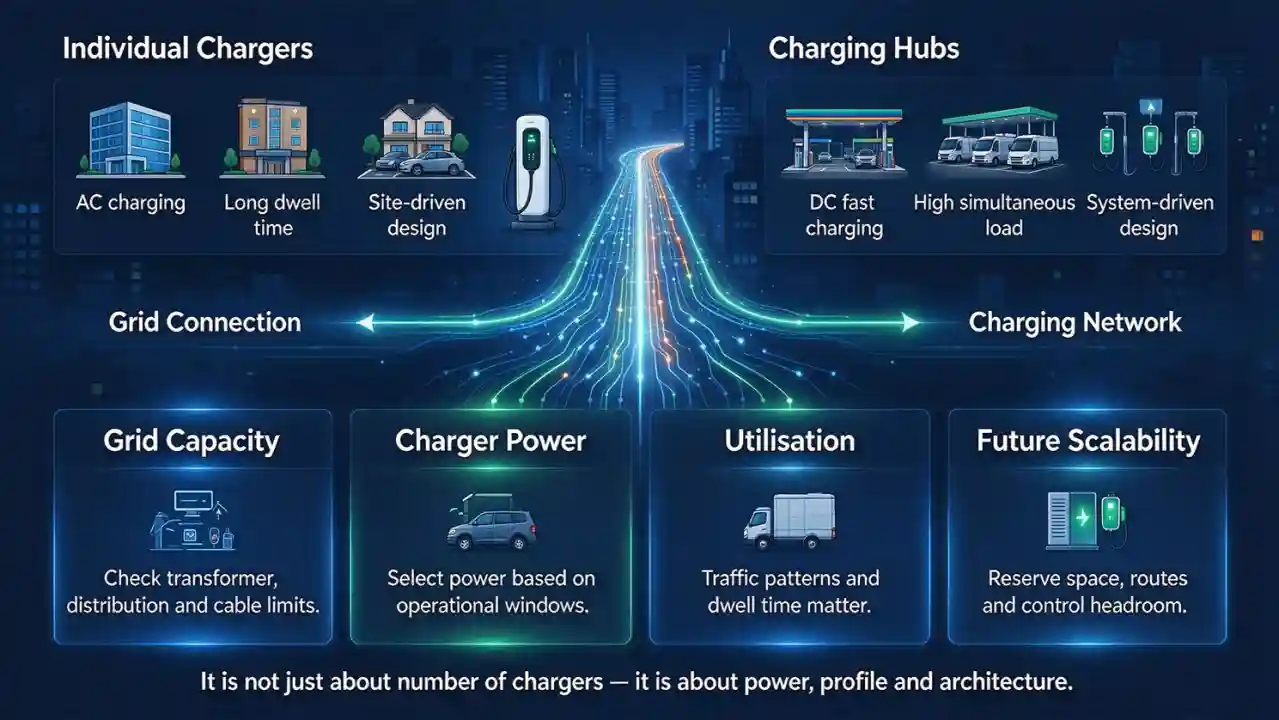
As electric vehicle adoption continues to expand, the design of EV charging infrastructure is becoming increasingly dependent on site-specific technical and operational requirements. For a business considering EV charging, the decision is no longer simply whether to install chargers, but how much charging capacity should be deployed, how that capacity should be distributed, and how the charging system should interact with the site's existing electrical infrastructure.
An office building, hotel, commercial property or residential development may only require several AC charging points because vehicles remain parked for relatively long periods. In contrast, a highway charging station, fleet depot or high-traffic commercial site may require multiple DC fast chargers operating simultaneously, making electrical capacity, load management and backend control much more important.
The difference between an individual charging installation and a dedicated charging hub therefore goes far beyond the number of charging points. It is fundamentally a question of power demand, utilisation, electrical infrastructure and system architecture.
Individual Charging Installations Are Usually Designed Around Existing Site Operations
An individual EV charging installation is normally added to an existing property where charging is not the primary function of the site. The charging infrastructure must therefore work within the existing electrical and operational environment rather than requiring the entire site to be designed around EV charging.
For example, a hotel may deploy 7 kW or 22 kW AC chargers for overnight guests, while an office building may use AC charging to provide employees with energy during working hours. A retail location may combine AC charging with one or more DC chargers so that customers can recharge while shopping.
The appropriate charging power in these applications depends heavily on vehicle dwell time.
If a vehicle remains parked for six hours, an AC charger delivering approximately 11 kW can theoretically provide a substantial amount of energy during that period without requiring the electrical infrastructure associated with a high-power DC charger. Increasing the charger rating does not necessarily improve the overall value of the installation if the vehicle is already receiving sufficient energy during its parking period.
This is an important principle in charging infrastructure design: charging power should be evaluated against energy demand and dwell time, rather than considered independently.
The situation changes when vehicles need to complete charging within a much shorter period. A fleet vehicle operating continuously throughout the day, for example, may only have a limited charging window between operating cycles. In such an application, higher-power DC charging can become more valuable because the objective is not simply to provide energy while the vehicle is parked, but to transfer a required amount of energy within a defined operational window.
A Charging Hub Introduces a Different Power Architecture
A dedicated charging hub is fundamentally different because charging becomes one of the site's primary functions. Multiple chargers may need to operate simultaneously, and the total installed charging capacity can become significant compared with the site's available grid capacity.
Consider a site equipped with eight 120 kW DC charging outputs. The theoretical installed charging capacity would be 960 kW. However, the site's actual electrical demand will not necessarily remain at 960 kW throughout operation.
The power delivered to each vehicle is influenced by the vehicle's maximum charging capability, battery voltage, state of charge, battery temperature and charging curve. At the same time, the charging station itself may have internal power limitations, and the site may impose an additional power limit based on the available grid connection.
Therefore, the relationship between installed charger capacity and actual site demand is not a simple one-to-one calculation.
This distinction becomes particularly important when operators evaluate infrastructure investment. Designing the electrical system only from the sum of charger nameplate ratings can result in significant overcapacity, while designing the system without considering simultaneous demand can create power constraints once utilisation increases.
The engineering objective is to understand the site's expected charging load profile and then design the electrical and control architecture around that profile.
Grid Capacity Can Become the Main Constraint
For high-power charging sites, the most significant technical limitation may not be the charger itself but the available electrical capacity at the site.
Several 120 kW or 240 kW DC chargers operating simultaneously can create a substantial demand on the upstream electrical system. Depending on the local grid conditions and project scale, the operator may need to evaluate the existing transformer capacity, incoming power supply, distribution equipment, cable sizing, protection coordination, voltage drop and maximum demand.
This means that charger selection should not be separated from electrical infrastructure planning.
For example, a site may have sufficient parking space for ten DC chargers, but the existing electrical connection may not support their simultaneous operation at full output. Expanding the grid connection may require additional transformer capacity, switchgear or other electrical infrastructure, increasing both project cost and implementation time.
For this reason, a technically appropriate charging solution is not necessarily the one with the highest possible output per charger. The better solution is often the one that makes the most effective use of the site's available electrical capacity.
Dynamic Load Management Can Change How Charging Capacity Is Utilised
Dynamic Load Management becomes increasingly important as the number and power of chargers increase.
Without active power management, multiple chargers may attempt to draw high power at the same time, potentially pushing the site's total demand beyond its predefined electrical limit. With DLM, the charging system can continuously monitor available capacity and allocate power between charging sessions according to predefined rules or real-time conditions.
For example, if a site has a maximum available charging capacity of 600 kW but the connected chargers have a combined rated capacity of 960 kW, the system does not necessarily need to operate all chargers at their maximum output simultaneously. Instead, the available 600 kW can be dynamically distributed according to the number of connected vehicles, their charging requirements and the operator's priorities.
The allocation can also change during a charging session. If one vehicle begins reducing its charging power as the battery approaches a higher state of charge, the available capacity can potentially be redirected to another vehicle.
This creates a distinction between installed capacity and managed capacity.
A charging site with a large installed charger capacity does not necessarily require an equally large continuous grid connection if the system has an appropriate power management architecture. However, the actual feasibility depends on the electrical design, charger configuration, utility requirements and control system.
Charging Utilisation Is More Important Than Charger Quantity
Another important consideration is utilisation.
A charging station with ten high-power chargers may have greater theoretical capacity than a station with four chargers, but this does not automatically mean that it will generate better operational performance. If charging demand is low for most of the day, a large amount of installed equipment may remain underutilised.
Conversely, a smaller charging site located in an area with high EV traffic can experience high utilisation and reach its practical capacity much earlier.
This is why charging infrastructure planning should consider the expected charging load profile rather than simply the number of charging points.
Traffic patterns, vehicle types, average dwell time, charging frequency, local EV adoption, nearby charging infrastructure and operating hours all influence the actual demand profile.
For fleet applications, the calculation can be even more specific because vehicle schedules are often predictable. A fleet operator may know when vehicles return to the depot, how much energy each vehicle requires and when the vehicles need to leave again. This allows the charging system to be designed around a defined energy and time requirement rather than an estimated public charging demand.
OCPP and Centralised Control Become More Important as the System Scales
As the number of charging points increases, the charging infrastructure becomes more dependent on software and communications.
Managing several chargers independently may be relatively straightforward, but operating a larger network requires centralised monitoring, configuration, transaction management, fault diagnosis and energy management.
OCPP provides a communication framework between charging stations and backend systems, allowing chargers to become part of a larger charging network rather than operating as isolated devices.
For commercial charging operators, the combination of charging hardware, OCPP communication and a Charging Station Management System can support functions such as remote monitoring, charging session control, configuration management, firmware updates, fault reporting and operational data collection.
The software architecture also becomes relevant to power management. When multiple chargers share limited electrical capacity, the backend or local energy management system needs to coordinate charging behaviour according to the site's power constraints.
This is one reason why charging infrastructure should increasingly be viewed as an integrated system consisting of power electronics, electrical distribution, communication, control and software, rather than simply a collection of charging units.
Future Expansion Should Be Considered During the Initial Design
Another technical consideration is scalability.
A site that requires four chargers today may require ten or twenty chargers several years later as EV adoption increases. If the initial electrical infrastructure has no provision for expansion, future deployment may require substantial reconstruction.
A more effective approach can be to design the initial project with future capacity in mind. This may involve reserving physical installation space, designing suitable cable routes, considering distribution capacity, preparing communication infrastructure and establishing a power management strategy that can accommodate additional charging equipment.
This does not mean that every project should install maximum capacity from the beginning. Overbuilding can create unnecessary capital expenditure and low asset utilisation.
Instead, the goal should be to create an infrastructure architecture that can scale without requiring the entire system to be redesigned.
Individual Chargers or Charging Hub?
There is no universal answer.
For locations where vehicles remain parked for extended periods and charging is primarily an additional service, AC charging or a limited number of DC chargers can often provide a technically and economically appropriate solution.
For locations where vehicles need rapid energy transfer, charging demand is concentrated within specific time periods, and multiple vehicles must be served simultaneously, a dedicated DC charging hub becomes more appropriate.
The important point is that the decision should be based on the relationship between energy demand, dwell time, charging power, utilisation and available electrical capacity.
A high-power charger is not automatically a better solution, just as installing more charging points does not automatically create a better charging business.
The infrastructure needs to match the operating characteristics of the vehicles and the electrical characteristics of the site.
Designing EV Charging as a System
As EV charging networks become larger and more technically complex, charger selection is only one part of the engineering process.
The charging system needs to be evaluated as an integrated architecture that includes the charging equipment, electrical distribution, power management, communication network, backend platform and future expansion requirements.
For charging operators, distributors, EPC contractors and fleet businesses, this approach can help avoid two common problems: installing significantly more capacity than current demand can justify, or building an infrastructure system that cannot support future growth.
At SeconPower, we develop AC and DC EV charging solutions from 3.5 kW to 480 kW, with support for OCPP-based network management, Dynamic Load Management, RFID, payment systems, remote O&M and multiple charging connector standards.
For larger charging projects, the objective is not simply to maximise charger output. It is to coordinate power capacity, charging demand and operational control so that the infrastructure can deliver reliable performance while remaining scalable.