Why is Dynamic Load Balancing (DLB) for home EV chargers more important than you think?
Technical Insight] Why is Dynamic Load Balancing (DLB) for home EV chargers more important than you think?
For many EV owners and installers, the biggest worry regarding home charging is the circuit breaker tripping the moment the air conditioner or oven is turned on.
To fundamentally solve the issue of system overload, we have integrated Dynamic Load Balancing (DLB) technology into Qishi EV chargers. It is far more than simple current limiting; it is a comprehensive, round-the-clock home electrical safety system.
💡 How it works:
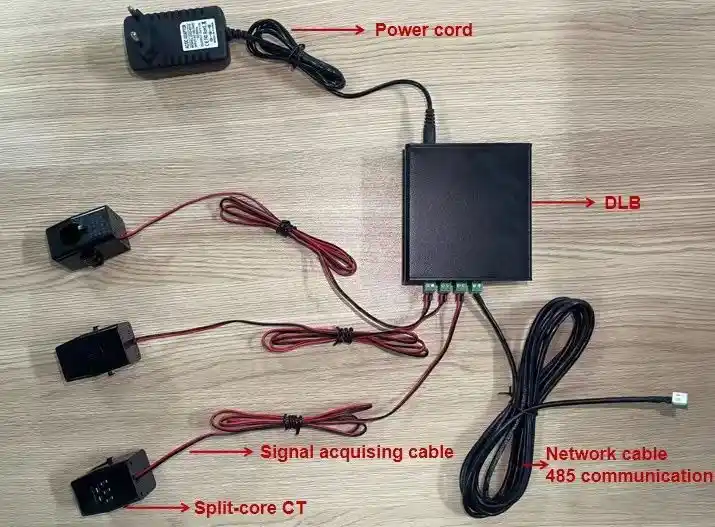
Real-time monitoring: A CT sensor is installed on the main power line to monitor the household's total power consumption in real-time. The system dynamically adjusts the charging current based on available capacity, ensuring the main circuit breaker does not trip.
Millisecond-level response: When high-power appliances (like air conditioners or ovens) start up and cause a surge in demand, the charger immediately reduces its output; once the appliances are turned off and the load drops, the charging power automatically and smoothly ramps back up.
Three-phase compatibility: For high-power models (such as 3-Phase 32A units), DLB monitors and regulates the load across phases L1, L2, and L3 in real-time, maintaining phase balance within the three-phase system.
🛡️ Example:
8A threshold pause mechanism: If the household's remaining available current drops below 8A, the charger automatically pauses charging; it resumes automatically once capacity frees up and the available current rises above 8A.
Simple deployment: Fully activate the DLB function by simply installing a compatible meter in the distribution box and connecting it to the charger.
While many products on the market claim to support DLB, the true differentiators of the user experience are response speed, phase-balancing algorithms, and hardware stability.
Striking the perfect balance between automated safety protection and charging efficiency—often imitated, never surpassed.
Dynamic Load Balancing is not only about overload protection, many people understand load management as a safety function. For example: When the total site load is too high, the system reduces charger output to avoid overload, this is correct. But for commercial EV charging sites, Dynamic Load Balancing can do more than that. It can also help the site use available power more efficiently. In real projects, not every EV charges at the same power all the time. Some EVs may only accept 6–7kW, some EVs may accept 16–18kW, some batteries may already be close to full, some charging sessions may stop earlier than expected. If every charger is treated as a fixed load, part of the site power may be wasted. With Dynamic Load Balancing, the system can monitor the available site capacity and adjust charger output based on real-time demand. This means the available power can be redistributed instead of being locked to each charger. For site owners and operators, this can bring several practical benefits:
✔ reduce overload risk
✔ avoid unnecessary grid upgrades
✔ install more charging points under the same grid limit
✔ improve the utilization of available power
✔ support future site expansion
So DLB should not be seen only as a protection function. For commercial charging sites, it is also a power utilization strategy. Because the real question is not only: “How do we prevent overload?” The better question is: “How can we use the available site power more intelligently?”
Why is Dynamic Load Balancing (DLB) essential in EV charging?
1. Preventing Overloads: DLB helps manage the total electrical load when multiple devices or charging stations are drawing power from a single source. It ensures the system doesn't exceed the capacity, preventing overloads that could trip breakers or cause power outages.
2. Optimizing Energy Use: DLB dynamically adjusts the power distributed to each charger based on real-time demand and available capacity. This allows efficient use of power without affecting other appliances, especially important in homes and businesses with limited electrical capacity.
3. Cost Efficiency: By optimizing the distribution of power, DLB helps avoid high-demand surges, which could increase electricity costs in areas with time-of-use or demand-based pricing.
4. Scalability and Flexibility: For businesses with multiple EV charging stations, DLB supports adding more chargers without needing costly electrical upgrades. It balances the load across chargers, making it easier to expand infrastructure as demand grows.
5. Enhanced User Experience: For users, DLB ensures their EVs can charge steadily, even when other devices are running or other cars are plugged in. It prevents one charger from monopolizing power, allowing fair distribution across all connected vehicles.
For details on the actual configuration and implementation of DLB for Qishi EV chargers, feel free to leave a comment or send a private message.
For many EV owners and installers, the biggest worry regarding home charging is the circuit breaker tripping the moment the air conditioner or oven is turned on.
To fundamentally solve the issue of system overload, we have integrated Dynamic Load Balancing (DLB) technology into Qishi EV chargers. It is far more than simple current limiting; it is a comprehensive, round-the-clock home electrical safety system.
💡 How it works:
Real-time monitoring: A CT sensor is installed on the main power line to monitor the household's total power consumption in real-time. The system dynamically adjusts the charging current based on available capacity, ensuring the main circuit breaker does not trip.
Millisecond-level response: When high-power appliances (like air conditioners or ovens) start up and cause a surge in demand, the charger immediately reduces its output; once the appliances are turned off and the load drops, the charging power automatically and smoothly ramps back up.
Three-phase compatibility: For high-power models (such as 3-Phase 32A units), DLB monitors and regulates the load across phases L1, L2, and L3 in real-time, maintaining phase balance within the three-phase system.
🛡️ Example:
8A threshold pause mechanism: If the household's remaining available current drops below 8A, the charger automatically pauses charging; it resumes automatically once capacity frees up and the available current rises above 8A.
Simple deployment: Fully activate the DLB function by simply installing a compatible meter in the distribution box and connecting it to the charger.
While many products on the market claim to support DLB, the true differentiators of the user experience are response speed, phase-balancing algorithms, and hardware stability.
Striking the perfect balance between automated safety protection and charging efficiency—often imitated, never surpassed.
Dynamic Load Balancing is not only about overload protection, many people understand load management as a safety function. For example: When the total site load is too high, the system reduces charger output to avoid overload, this is correct. But for commercial EV charging sites, Dynamic Load Balancing can do more than that. It can also help the site use available power more efficiently. In real projects, not every EV charges at the same power all the time. Some EVs may only accept 6–7kW, some EVs may accept 16–18kW, some batteries may already be close to full, some charging sessions may stop earlier than expected. If every charger is treated as a fixed load, part of the site power may be wasted. With Dynamic Load Balancing, the system can monitor the available site capacity and adjust charger output based on real-time demand. This means the available power can be redistributed instead of being locked to each charger. For site owners and operators, this can bring several practical benefits:
✔ reduce overload risk
✔ avoid unnecessary grid upgrades
✔ install more charging points under the same grid limit
✔ improve the utilization of available power
✔ support future site expansion
So DLB should not be seen only as a protection function. For commercial charging sites, it is also a power utilization strategy. Because the real question is not only: “How do we prevent overload?” The better question is: “How can we use the available site power more intelligently?”
Why is Dynamic Load Balancing (DLB) essential in EV charging?
1. Preventing Overloads: DLB helps manage the total electrical load when multiple devices or charging stations are drawing power from a single source. It ensures the system doesn't exceed the capacity, preventing overloads that could trip breakers or cause power outages.
2. Optimizing Energy Use: DLB dynamically adjusts the power distributed to each charger based on real-time demand and available capacity. This allows efficient use of power without affecting other appliances, especially important in homes and businesses with limited electrical capacity.
3. Cost Efficiency: By optimizing the distribution of power, DLB helps avoid high-demand surges, which could increase electricity costs in areas with time-of-use or demand-based pricing.
4. Scalability and Flexibility: For businesses with multiple EV charging stations, DLB supports adding more chargers without needing costly electrical upgrades. It balances the load across chargers, making it easier to expand infrastructure as demand grows.
5. Enhanced User Experience: For users, DLB ensures their EVs can charge steadily, even when other devices are running or other cars are plugged in. It prevents one charger from monopolizing power, allowing fair distribution across all connected vehicles.
For details on the actual configuration and implementation of DLB for Qishi EV chargers, feel free to leave a comment or send a private message.
- Previous: Canton Fair Gold Partner
- Next: What's the V2G benefits and advantages?