

Which OCPP Version Should a New EV Charging Project Choose?
⚡Which OCPP Version Should a New EV Charging Project Choose?
As EV charging networks become more connected and intelligent, OCPP is playing an increasingly important role in communication between EV chargers and backend management platforms.
But what are the real differences between OCPP 1.6J and OCPP 2.0.1?
In our latest article, we break down the key differences in:
🔹 Device management
🔹 Transaction handling
🔹 Smart charging & dynamic load management
🔹 ISO 15118 & Plug & Charge
🔹 Cybersecurity & certificate management
🔹 High-power DC charging and fleet applications
🔹 Compatibility with third-party CSMS platforms
🔹 How to choose the right OCPP version for a new project
Whether you are an EV charger manufacturer, CPO, EMSP, system integrator, distributor, or commercial charging project owner, understanding these differences can help you evaluate the right charging solution for your project.
OCPP 1.6J vs OCPP 2.0.1: Which One Fits Your EV Charging Project?
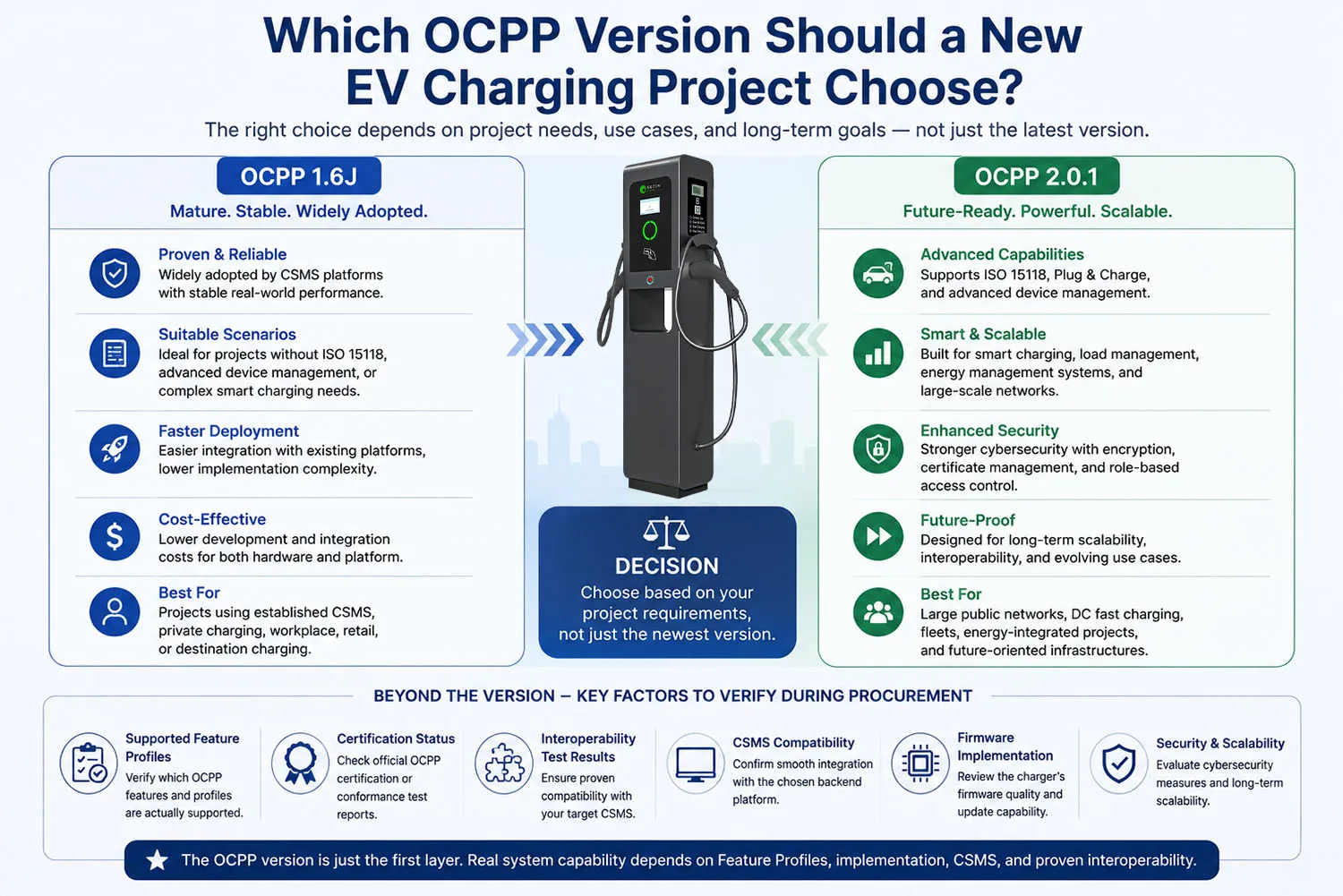
The choice between OCPP 1.6J and OCPP 2.0.1 should ultimately be based on project requirements rather than simply assuming that the newer protocol is always the better option.
If a project relies on an established third-party CSMS platform that already operates reliably with OCPP 1.6J, and the project does not require ISO 15118, advanced device management, or complex smart charging capabilities, OCPP 1.6J can remain a mature and practical choice.
For new large-scale public charging networks, high-power DC EV charging stations, fleet charging infrastructure, intelligent load management, energy management systems, ISO 15118, or projects requiring stronger cybersecurity and long-term scalability, OCPP 2.0.1 is generally worth prioritizing during the technical evaluation process.
However, “OCPP 2.0.1 compatible” alone does not mean that an EV charger implements every feature defined by the protocol. During procurement, project owners should verify the specific supported functional modules, certification status, interoperability test results, and compatibility with the target CSMS. For commercial EV charging projects, the OCPP version is only the first layer of technical evaluation. The actual system capability depends on the supported Feature Profiles, charger firmware implementation, backend platform, and proven interoperability between the EV charger and CSMS.
#EVCharging #OCPP #OCPP201 #OCPP16J #DCFastCharging #EVInfrastructure #SmartCharging #ISO15118 #EVChargingStation
As EV charging networks become more connected and intelligent, OCPP is playing an increasingly important role in communication between EV chargers and backend management platforms.
But what are the real differences between OCPP 1.6J and OCPP 2.0.1?
In our latest article, we break down the key differences in:
🔹 Device management
🔹 Transaction handling
🔹 Smart charging & dynamic load management
🔹 ISO 15118 & Plug & Charge
🔹 Cybersecurity & certificate management
🔹 High-power DC charging and fleet applications
🔹 Compatibility with third-party CSMS platforms
🔹 How to choose the right OCPP version for a new project
Whether you are an EV charger manufacturer, CPO, EMSP, system integrator, distributor, or commercial charging project owner, understanding these differences can help you evaluate the right charging solution for your project.
OCPP 1.6J vs OCPP 2.0.1: Which One Fits Your EV Charging Project?
The choice between OCPP 1.6J and OCPP 2.0.1 should ultimately be based on project requirements rather than simply assuming that the newer protocol is always the better option.
If a project relies on an established third-party CSMS platform that already operates reliably with OCPP 1.6J, and the project does not require ISO 15118, advanced device management, or complex smart charging capabilities, OCPP 1.6J can remain a mature and practical choice.
For new large-scale public charging networks, high-power DC EV charging stations, fleet charging infrastructure, intelligent load management, energy management systems, ISO 15118, or projects requiring stronger cybersecurity and long-term scalability, OCPP 2.0.1 is generally worth prioritizing during the technical evaluation process.
However, “OCPP 2.0.1 compatible” alone does not mean that an EV charger implements every feature defined by the protocol. During procurement, project owners should verify the specific supported functional modules, certification status, interoperability test results, and compatibility with the target CSMS. For commercial EV charging projects, the OCPP version is only the first layer of technical evaluation. The actual system capability depends on the supported Feature Profiles, charger firmware implementation, backend platform, and proven interoperability between the EV charger and CSMS.
#EVCharging #OCPP #OCPP201 #OCPP16J #DCFastCharging #EVInfrastructure #SmartCharging #ISO15118 #EVChargingStation