EV Charging Connector Standards: Regional and Technical Overview
EV Charging Connector Standards: Regional and Technical Overview
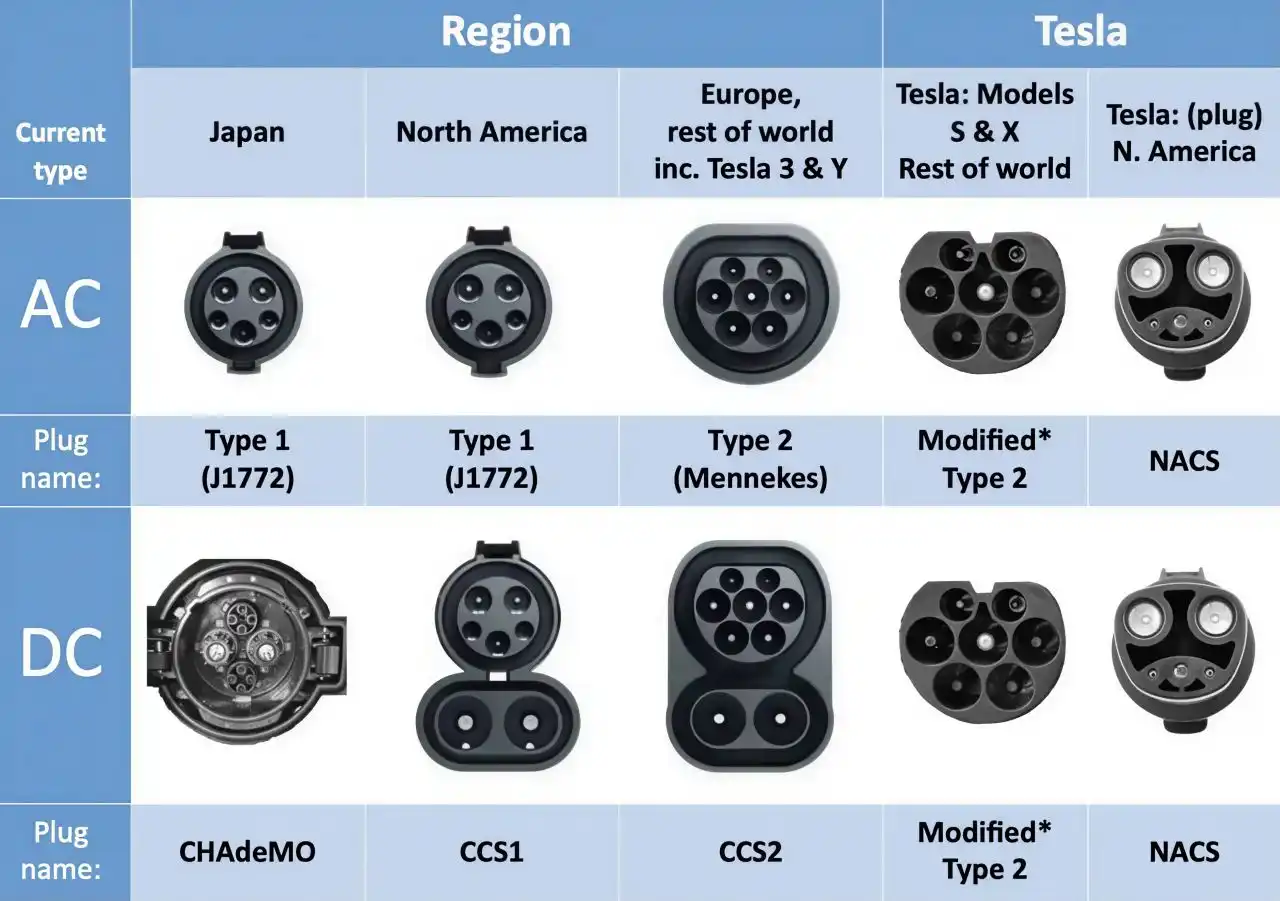
The charging-connector landscape for Electric Vehicles (EVs) is primarily shaped by regional standards, vehicle architecture, and charging infrastructure requirements. As illustrated, different markets have adopted distinct connector configurations for AC (Alternating Current) and DC (Direct Current) charging, resulting in several globally recognized standards.
In Japan, the Type 1 (J1772) connector is commonly associated with AC charging, while CHAdeMO is used for DC fast charging. North America traditionally uses Type 1 (J1772) for AC charging and CCS1 for DC fast charging. In contrast, Europe and many other global markets predominantly use Type 2 (Mennekes) for AC charging and CCS2 for DC fast charging.
Tesla has developed and adopted region-specific charging solutions. In several markets outside North America, Tesla vehicles have historically used a modified Type 2 configuration, while in North America, Tesla uses the NACS (North American Charging Standard) connector, which supports both AC and DC charging through a single compact interface.
From an engineering perspective, the major difference between these systems is not only the physical connector design but also their electrical architecture, communication protocol, power-handling capability, safety mechanisms, and charging control strategy. CCS systems, for example, integrate AC and high-power DC charging into a common vehicle inlet, whereas CHAdeMO follows a dedicated DC fast-charging interface.
Overall, the evolution of EV charging standards reflects the industry's movement toward higher charging power, improved interoperability, compact connector design, enhanced safety, and faster communication between the EV and charging station. Understanding these regional standards is therefore essential for EV service engineers, battery-pack designers, charging-infrastructure developers, and technicians involved in the global EV ecosystem.