If a charger cable is stolen at one of your sites, how do you usually confirm the right replacement cable?
If a charger cable is stolen at one of your sites, how do you usually confirm the right replacement cable?
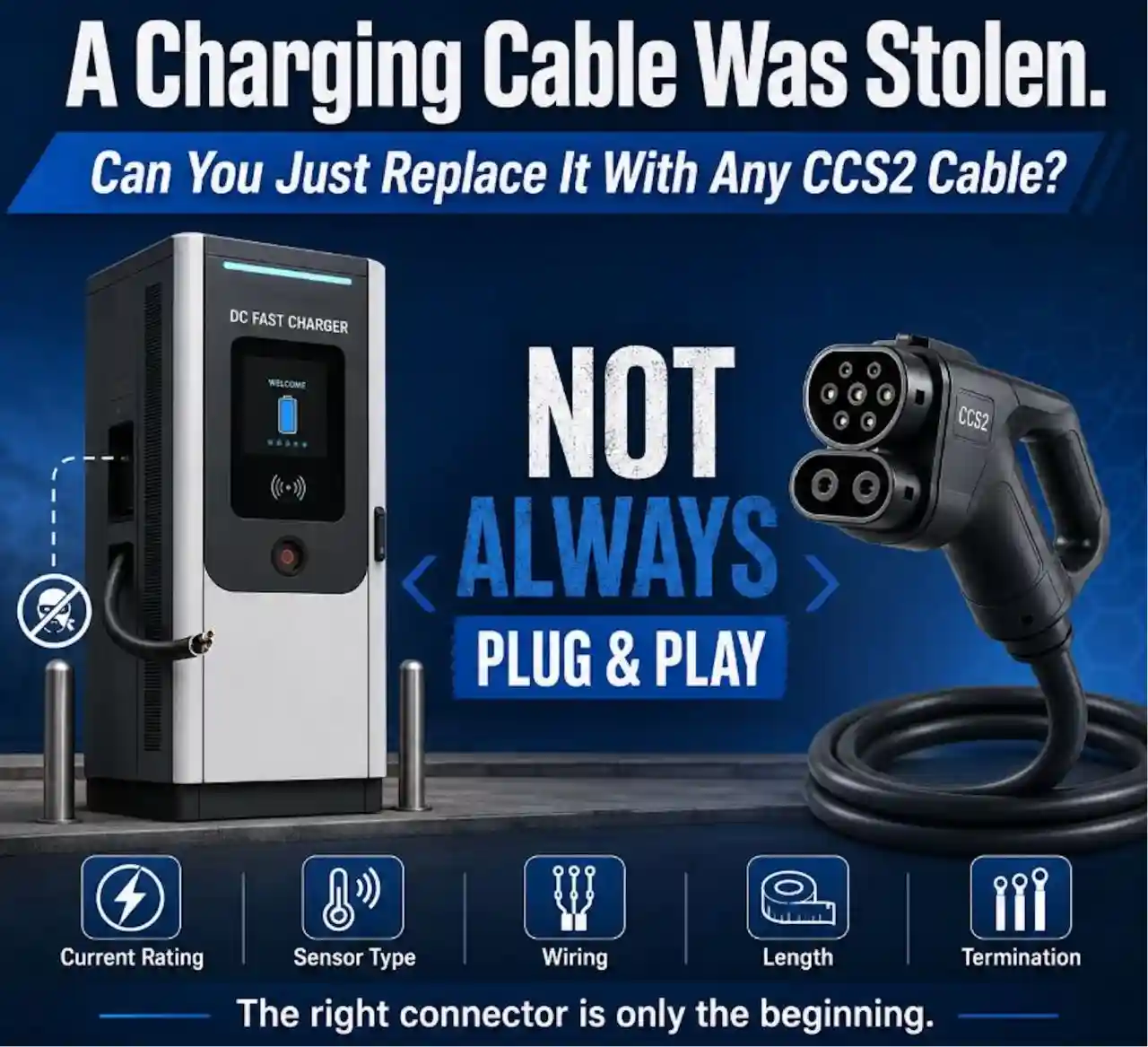
A friend recently sent me a video from overseas. A public EV charger had its charging cable cut and stolen. The first reaction is usually simple:“Just install another CCS2 cable.”
But in real maintenance work, it is often not that simple. Because CCS2 only tells you the connector standard. It does not guarantee that any replacement cable will work correctly with the charger.
When replacing a stolen or damaged charging cable, you may still need to match:
1. Current rating
2. Cable length
3. Cable structure
4. Temperature sensor type
5. Signal wiring
6. Locking structure
7. Charger-side termination
8. Mechanical installation details
So even if two cables both look like CCS2, they may not be truly interchangeable, and this is where many operators lose time, the charger is offline, and drivers are waiting, revenue is lost. But the wrong replacement cable can create another problem: The connector fits, and the charger still doesn’t return to service properly. That is why replacement cables should not be treated as “just another spare part.” They need to match the charger’s original configuration as closely as possible.
At Qishi EV Charger, when we support replacement EV charging cables, we do not start with only one question:“Is it CCS2?”. We start with the more important one:“Which charger are you trying to get back online?”
Because restoring service quickly usually depends on getting the right replacement, not just a replacement.
We support customers with:
1. OEM from 1 piece
2. Replacement based on original specification
3. Stable quality
4. Fast delivery
5. Local payment support
6. Lower spare stock pressure
A stolen charging cable is a security problem, but for operators, it quickly becomes a replacement compatibility and uptime problem too.
A friend recently sent me a video from overseas. A public EV charger had its charging cable cut and stolen. The first reaction is usually simple:“Just install another CCS2 cable.”
But in real maintenance work, it is often not that simple. Because CCS2 only tells you the connector standard. It does not guarantee that any replacement cable will work correctly with the charger.
When replacing a stolen or damaged charging cable, you may still need to match:
1. Current rating
2. Cable length
3. Cable structure
4. Temperature sensor type
5. Signal wiring
6. Locking structure
7. Charger-side termination
8. Mechanical installation details
So even if two cables both look like CCS2, they may not be truly interchangeable, and this is where many operators lose time, the charger is offline, and drivers are waiting, revenue is lost. But the wrong replacement cable can create another problem: The connector fits, and the charger still doesn’t return to service properly. That is why replacement cables should not be treated as “just another spare part.” They need to match the charger’s original configuration as closely as possible.
At Qishi EV Charger, when we support replacement EV charging cables, we do not start with only one question:“Is it CCS2?”. We start with the more important one:“Which charger are you trying to get back online?”
Because restoring service quickly usually depends on getting the right replacement, not just a replacement.
We support customers with:
1. OEM from 1 piece
2. Replacement based on original specification
3. Stable quality
4. Fast delivery
5. Local payment support
6. Lower spare stock pressure
A stolen charging cable is a security problem, but for operators, it quickly becomes a replacement compatibility and uptime problem too.